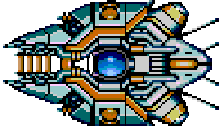
I was just playing a game the other day and it occurred to me to wonder about the logic here. Consider this: in the Konquest Mode of Mortal Kombat Armageddon, there are two game modes. There is the walking/fighting mode that is most of the game, which plays sort of like a 3D beat-em-up style. In this mode, you have a few standard punch and kick moves, and a few special moves once you unlock them. So far, so good. However, in this mode you have no actual weapons except temporary ones given to you in a specific areas. Now, then, at certain points there is a second mode that plays like the standard Mortal Kombat style one-on-one battles. In this mode, you can wield a sword if you choose, but that sword does not seem to exist in the other mode. This is what I like to call "Video Game Logic" or simply "VGL."
So, let's discuss our favorite (or least favorite) VGL experiences!
Invisible boundaries. If you are gonna wall of areas, use chasms, walls or something that might actually make sense. And if you wanna go into more detail on why said chasm/wall is unpassable, make them inclined/whatever to make them unclimbable or whatever. OR put lava in the chasm. I don't care, just make a logical excuse why I can't go somewhere other than invisible walls outta no where UNLESS a wizard/spellcaster puts them there in the middle of a fight or something for THAT area ( and NOT THE WHOLE DAMN WORLD)
Here's one of my favorites: Chrono Trigger. When you first battle Magus in his castle, near the end of the battle he uses the spell Dark Matter. Later in the game, Magus can optionally join your group, but DOES NOT have this spell yet! So how the blazing frack was he able to cast it before!? That is more VGL that makes no sense.
TheDarkOne wrote:Here's one of my favorites: Chrono Trigger. When you first battle Magus in his castle, near the end of the battle he uses the spell Dark Matter. Later in the game, Magus can optionally join your group, but DOES NOT have this spell yet! So how the blazing frack was he able to cast it before!? That is more VGL that makes no sense.
Explained in-game. Remember when Magus (fruitlessly) attacked Lavos in the Ocean Palace? Lavos drains his power here. Magus even says so. Leveling him up is a road to recovery.
King Aquamentus wrote:Explained in-game. Remember when Magus (fruitlessly) attacked Lavos in the Ocean Palace? Lavos drains his power here. Magus even says so. Leveling him up is a road to recovery.
I was under the impression that Lavos "draining his power" meant his MP, not his actual magic abilities. I suppose that does make sense when you put it that way. I never thought of that.
But here's a major one from the same game: Lavos lays waste to their world when it awakens in 1999 AD. Crono and co find this out during a visit to 2300 AD. But, no matter what method you use to get to it, the final battle always takes place in 1999 AD. So by destroying Lavos in that time period, the version of 2300 AD they visited never would have happened and they would never have known about Lavos, so never would have battled it. Time paradox.
TheDarkOne wrote:
But here's a major one from the same game: Lavos lays waste to their world when it awakens in 1999 AD. Crono and co find this out during a visit to 2300 AD. But, no matter what method you use to get to it, the final battle always takes place in 1999 AD. So by destroying Lavos in that time period, the version of 2300 AD they visited never would have happened and they would never have known about Lavos, so never would have battled it. Time paradox.
I think they touch upon that in Chrono Cross, but I could be wrong (I haven't played it for almost a decade). I do remember that one of the main plot points is that Crono and friends' meddling with time to defeat Lavos caused alternate time-lines/dimensions/whatever (ie: a time-line where the reptites won). Heck I think the Dead Sea or whatever its called in the game is where you learn about it from little "ghosts" (for lack of a better term) of Crono, Marle and Lucca as kids.
But then again, I haven't played the game in almost a decade and my memory is spotty at best. (and to get back on topic...)
In the first Ninja Turtles game on the NES, when one of your turtles "dies", he demutates into his normal turtle form/whatever. However, its possible to find them, fully mutated, and tied up in certain areas that the Foot controls and save them. My question is, if they demutate when defeated, why would the foot remutate them instead of leaving them be or simply killing them, their worst enemy, in a weakened state?
Relating to Chrono Cross, I don't play that game because the battle system is too weird and confusing for my taste, and I don't think it count as a "true" sequel to Chrono Trigger anyway. Originally the game was titled Radical Dreamers and did not contain any reference to Chrono Trigger.
About TMNT, that always confused me, too. The game does this so you can regain a captured Turtle. But the only explanation I can come up with is that the "demutation" is temporary and the Turtle "remutates" shortly afterward. As for not killing them outright, perhaps they are under orders from Shredder to leave them alive so he can execute them himself later.
Another one is common in many platform games, but especially in the Mario series. Almost all Mario games contain underwater levels which Mario can swim through (and does not appear to have any need for air, but let's not go there just yet). In other levels there is only surface water, which will instantly kill Mario if he falls into it. Why can he swim in some levels and not in others?
TheDarkOne wrote:Relating to Chrono Cross, I don't play that game because the battle system is too weird and confusing for my taste, and I don't think it count as a "true" sequel to Chrono Trigger anyway. Originally the game was titled Radical Dreamers and did not contain any reference to Chrono Trigger.About TMNT, that always confused me, too. The game does this so you can regain a captured Turtle. But the only explanation I can come up with is that the "demutation" is temporary and the Turtle "remutates" shortly afterward. As for not killing them outright, perhaps they are under orders from Shredder to leave them alive so he can execute them himself later.
Another one is common in many platform games, but especially in the Mario series. Almost all Mario games contain underwater levels which Mario can swim through (and does not appear to have any need for air, but let's not go there just yet). In other levels there is only surface water, which will instantly kill Mario if he falls into it. Why can he swim in some levels and not in others?
I never had a problem with Cross's battle system, but then again, I'm fairly adaptable to control schemes it seems. On another note, Radical Dreamers does exists, but its a "novel adventure" (ie: zork, with less dark loving flesh eating beasties) for the super famicom (there is an english translation patch).
On Mario, the first game had you enter warp pipes between levels so maybe they granted water-related abilities? :shrug:
I didn't know much about Radical Dreamers, just that it was original game that became Chrono Cross. I like text-based adventure games, even programmed some myself, so if I can somehow get my hands on the English version, I'll give it a try.
Let's talk about Final Fantasy for a moment: the first one, in fact. These four people show up out of nowhere with these orbs, just when things are getting bad? Awfully convenient, no? And they just happen to be there right on time to rescue the kidnapped princess. How nice.
Chrono Cross is weird and confusing. Basically since Lavos exists in all times at once (or something), being killed in 1999 convinced it to simply assimilate Schala during the fall of Zeal in 12,000 BC and feed on her desire to either cease existing or make everything else cease to exist. Before it took her over though, she heard Serge in distress in 1010-ish AD and figuratively raised hell to interfere through time and save him. This cause a huge storm and error in 2400 AD which sent a Time research station into the stone age and created a reptite version of it, and uh... beyond that I"m not sure. Also kid works into Schala trying to save Serge somehow and is like an avatar of Schala or something. I don't know even the ending is ambiguous.
Anyways
One thing I've always waxed heavily on in games is the volatility of the dead, or thoroughly defeated. Being dead in games is like being a witch splashed with water: seconds later, there's nothing but a few puffs of steam. This makes sense purely from a game's standpoint since bodies add up, get taxing on the system, and generally are a little disturbing to all see laying around, but... if you were Mario, and you really were in the mushroom kingdom, would every flattened goomba's flesh start to rapidly evaporate in a matter of seconds?? Would there be tall wisps of steam everywhere you go from all the enemies you killed? Or are there just smeared corpses all over the place and some poor mushroom guy with a mop saying how much he hates his job?
King Aquamentus wrote:One thing I've always waxed heavily on in games is the volatility of the dead, or thoroughly defeated. Being dead in games is like being a witch splashed with water: seconds later, there's nothing but a few puffs of steam. This makes sense purely from a game's standpoint since bodies add up, get taxing on the system, and generally are a little disturbing to all see laying around, but... if you were Mario, and you really were in the mushroom kingdom, would every flattened goomba's flesh start to rapidly evaporate in a matter of seconds?? Would there be tall wisps of steam everywhere you go from all the enemies you killed? Or are there just smeared corpses all over the place and some poor mushroom guy with a mop saying how much he hates his job?
Four possible explanations for Mario and one for Zelda games. As for others... well, I guess the player's weapons are actually a form of Zat'nik'tel. : P
Mario
1.) It's an early warning system
The rising smoke from the deceased troops warns Bowser to set up the traps in the next castle. I mean, who builds a castle with no floor?! That's definitely some sort of defense mode that gets activated on Mario's approach.
2.) The enemies are illusions/magically constructed
Goombas are actually mushroom kingdom residents that didn't have the good sense to turn themselves into blocks before Bowser cursed everybody (well, at least in the original). Perhaps their vanishing in a puff signals an end to the spell, and they wake up back in their homes back to normal. The Paper Mario series sort of contradicts this, but it's a thought.
3.) They're kicked into the foreground
When Mario dies he falls off the level. Where do all his extra bodies go? You know, the ones that died before the 1UpShroom cloned him? They're piled up under the screen, with all the goombas and koopa troopas he's been slaying the whole time. This theory actually gets MORE plausible when you consider the 3D titles. Have you ever noticed that EVERY area in the mushroom kingdom hovers over an abyss? That's where they put all of the bodies. (This option may have been inspired by a weird PS3 game called Catherine).
4.) They're teleported to the Underwhere
This is where you go when all your games be over. Super Paper Mario supports this, as the afterlife is a physical place that can be reached from Flipside.
Zelda
1.) GANNON-BANNED TO THE EVIL JAR
Enough said.
Something that's always bothered me about video games and particularly RPGs is the fact that the world is coming to an end, but all of the magic McGuffins you need to stop it are conveniently located within the same country or--if not--tucked tidily in the center of some ancient ruin. The magic nya-nya is never accidentally buried in somebody's backyard or dropped in the ocean or something.
Kid is actually a clone of Schala, if I remember correctly. That's another VGL scenario.
RESIDENT EVIL SPOILERS BELOW! READ AT OWN RISK!
Does anyone remember Resident Evil 2? Especially when you play the B game as Leon. Ada Wong clearly dies right in front of Leon's eyes (as opposed to his A game where she simply falls off the ledge). But, when fighting T-01, she appears and throws you a rocket launcher. How did she come back to life?
Not only that, but when the two of them meet again in Resident Evil 4, Leon never thinks to ask her what happened. He saw her die, yet here she is alive and well, and he doesn't even question it? Maybe there is some untold story about the two of them that takes place between RE2 and RE4 (and it's not RE3 because that game takes place just before the events of RE2 and focuses on Jill Valentine).
As far as the Mario enemies thing and whatnot, I don't know of any in-game source up until now (I haven't played a lot of the newer Mario games except for the 1st Galaxy game, 3D Land, and New Super Mario Bros 2), but I can say that I know of one possible (non-canon/fanmade) explanation that not only kinda makes since, but is entertaining to say the least is this: http://brawlinthefamily.keenspot.com/characters/reario/
I can't commit on RE2 as I never played it for more that a few minutes (I couldn't get used to the controls and died when I started the game the first time. sad, but true)
The Sonic games: Eggman/Robotnik thought it was a good idea to make machines that not only leave him mostly vulnerable to attack, but also are easily destroyed upon him taking a set amount of damage, but the machines themselves were never attacked. This is true for (almost) every boss fight he is in (among others)
On that note, Gradius. Several models of Big Core (and its cousins) all have a series of bars which act as weak shields protecting their inner core.

Other cores such as the Death series demonstrate that the Bacterion forces are not limited by this kind of easily-destroyed defense so... ...why do they still have craft which use it?
Attachments:

Going back for a moment to Chrono Trigger: when exploring Guardia Castle in 600 AD, I have noticed that going up the stairs on the left side of the throne room leads to the top of a tower where you'll find the King's bedroom. However, going up the stairs on the right side of the throne room leads to the top of a tower containing the Queen's bedroom. Why would the King and Queen have bedrooms that are not only separate, but on opposite sides of the castle?
This might have something to do with medieval norms and standards. Back in the day, I believe the King and Queen would usually only consumate to produce heirs (especially as they rarely had any real attraction to each other.) If the King really wanted some fine booty he could pretty much get it wherever he wanted. Aside from that, even a married couple sleeping together regularly may have been frowned upon back then. I'm not totally sure.
Alternatively, its possible that the room we see is not actually the Queen's. Marle just goes there because she knows it as her room. Multiple servants note that the queen is acting odd, after all.
King Aquamentus wrote:Alternatively, its possible that the room we see is not actually the Queen's. Marle just goes there because she knows it as her room. Multiple servants note that the queen is acting odd, after all.
Someone does tell Crono that "The Queen is waiting for you in her room" so that indicates that it is in fact her room. But it is my understanding that in medieval times it was considering acceptable for married couples to sleep in the same bed. And the King and Queen of Guardia in 600 AD did clearly love one another.
There are probably way too many VGL scenarios in Chrono Trigger and Chrono Cross to discuss them all here. That kind of thing could have its own thread.
So how about Final Fantasy in general? Ever notice that the towns you visit always have better equipment (weapons, armor, accessories) than the towns before it? And if an upcoming boss has a specific weakness, a weapon that can exploit that weakness is available to either find or purchase before you fight said boss. You might as well just have the boss hand you a weapon and say "this is the weapon that is most effective against me."
Final Fantasy brings me back to the volatility thing. You know for sure someone has died when their body blinks out of existence (and I'm not talking about in battles: even the early 2D games make it clear that an enemy fading away in a battle literally only indicates that they lost that fight. They could reappear on the overhead mode two seconds later, saying something like "damn you guys are good ok you beat me I'll let you through." I'm talking about when people die on that overhead mode.) However, the 2D games sometimes play this like their bodies really are mysteriously destroyed, right before their eyes. When a mortally wounded character first starts to blink, everyone in the room reacts with great shock as if they're seeing it happen before their eyes. Plus, you cannot recover any effects that were on their person, and sometimes the fact that they had something that would have been useful becomes a plot point in the fact that because they are dead, it cannot be recovered.
Counterpoint: Locke keeps a corpse in his basement. Then again I don't think anyone mysteriously dissolves when they die in FF6.
Doom - or really a lot of early FPS games - the levels just tended to be a bunch of random mazes, done up to look like they're actual places. Doom in particular, though, because it was advanced enough that the level designers could add quite a bit of detail. In earlier games like Wolfenstein, yeah, you could only design levels on a square grid, which severely limited the kinds of levels you could design. However, Doom allowed for the possibility of archways, stairs, windows, walls jutting at any angle, skylights, etc. However, when you get down to it, while the levels look nice, they're just mazes, even though they're supposed to be representations of real-world places. Why does a base on Mars have all these random corridors, walls at random angles, passageways that lead nowhere, etc.? Doom 2 really takes the cake, because the second act takes places in a city, and while it certainly has a city-type aesthetic to it, it doesn't look like a real city - buildings are haphazardly strewn about at random and make no sense, there are no streets, there are all kinds of randomly placed stairs and lifts, the interiors are mazes... It's like, if this is how people were designing cities, they were doomed well before any demon invasion ever took place. Again, I know part of that was the limitations of the engine, I just find it funny, especially because when I design my own Doom levels, I always take into account, "Okay, this is a real place, I have a certain layout in mind for gameplay purposes, but how do I logically make the level fit the layout so that it looks like this could be a real place?" So for instance, I'll add fake doors to indicate there are other places you could go to if they weren't locked, I build it so that if you look out the window, you can see other parts of the base that aren't part of the map, if I have a cargo area, I make the doors big enough that the crates inside could actually fit there, etc.
To be honest, I'm still too hung-up on wall turkeys to be able to form anything resembling a coherent thought related to the topic.
Wall turkeys. Honestly.
EDIT: Oh, and this. There's got to be some explanation for that.
Here's another one relating to Resident Evil. When you find certain keys, your map automatically changes to show which door that key will open. Oh, and when you have unlocked all the doors you can with said key, somehow you automatically know that "this key is useless now" and you can "discard" it. Really, it's so nice to be clairvoyant enough to know when no more doors can be unlocked by a certain key.
Another one I've noticed when playing some old-school stuff. The classic game Elevator Action is an awesome game and a format that isn't used much. Here is my only issue with it: sometimes when you enter a red door to retrieve whatever documents you are after, you will exit the room only to have one of the enemy agents come out right behind you. It seems to me if he was in the room when you entered, either you or he would have been shot. Even if he was hiding, he still would have tried to kill you while in the room, since that is precisely what he tries to do after you both leave the roon.
Maybe your character shot out the light in the room and is now being chased?
I think he would need to be able to see in order to collect the documents he was after.
Final Fantasy VI..does this strike anyone else as odd? (SPOILER ALERT) Terra was taken by the Empire as a baby, so was likely raised to believe in the Empire and its rule. So then why do they have to use a "slave crown" to make her do their bidding? Would she not work for the Empire of her own free will, being that it was what she believed was right?
To some extent, yes, but unlike the mage knight Celes her power was not one that the empire designed and so it was inherently unstable. Also, both Celes and Cid were raised in the Empire and both railed against the authority. It is possible that as Terra grew into her powers she saw the corruption and attacked (I seem to recall the opening mention her as the witch that burned some soldiers), only to lose her memory of the whole situation after being subjected to the slave crown.
I think she did that AFTER being subjected to the Slave Crown, to test her powers. Or, as you said, she could have lost control of her powers and killed those 50 soldiers, hence the Slave Crown. I hadn't thought of it that way.
From the same game, Celes was a general and high-ranking in the Imperial army, but she then changes her mind and defects, but it is never fully explained WHY she changed. It is only said that she "realized the war was stupid." She was fighting in this war, so what happened that made her see the stupidity of it? Why is this never explained?
(Man, I really need to play 6 again)
Perhaps Celes turned away as the emperor put more and more faith into his newest general Kefka. The man was clearly insane; his actions even drove General Leo to defect (though it didn't work out so well for Leo) after that fiasco with the Espers. Seeing something you believe in fall to the madness of a charismatic lunatic can be pretty jarring, to the point where death seems the preferable option.
I don't know, though. It sort of feels like the plot started as a story about a magical amnesiac but Terra didn't have any romantic prospects, so they redirected to another lead. I mean romantic prospects in both senses: an interpersonal relationship with someone who literally knows nothing about the world or her past is inappropriate and the tension of knowing nothing is shattered as soon as the character learns her past; there's just not a lot of room there to be dynamic as a protagonist.
Conversely, Celes presented several avenues of literary growth; she walked the road of seeing the corruption behind something she believed in, suffered the catastrophic grief of knowing that her actions directly lead to the destruction of the world, and carried the weight of knowing the man she had feelings for was using her as a surrogate for his dead fiance. She's an incredibly deep character and perhaps the writers felt that supplying more details of her past before the defection would rob the audience of making their own leaps. It's a parabolic correlation, where too few or too many details generate disinterest in the audience.
Changing the subject, in the Sega Genesis version of the Jurassic Park game you can play as a raptor, but the raptor is specifically hunting Doctor Grant. There are literally DOZENS of guards in the game (which, by the way, doesn't make sense because the island was evacuated in anticipation of the incoming tropical storm) but none of them are good enough to eat. No, it has to be Doctor Grant. ...Why?
CJC wrote:
Something that's always bothered me about video games and particularly RPGs is the fact that the world is coming to an end, but all of the magic McGuffins you need to stop it are conveniently located within the same country or--if not--tucked tidily in the center of some ancient ruin. The magic nya-nya is never accidentally buried in somebody's backyard or dropped in the ocean or something.
In Ultima IV, there are three items that are require a ship so you can recover them from under the waves. Of course, this is as simple as going to the location and choosing "search." Then again, the stones you need in the same game are all in dungeons, which are kinda like ancient ruins.
TheDarkOne wrote:
So how about Final Fantasy in general? Ever notice that the towns you visit always have better equipment (weapons, armor, accessories) than the towns before it? And if an upcoming boss has a specific elemental weakness, a weapon that can exploit that weakness is available to either find or purchase before you fight said boss. You might as well just have the boss hand you a weapon and say "this is the weapon that is most effective against me."
But the shopkeep needs to sell it to you for 500,000 gp, then retire to his own private island. After the world is saved, of course! You should
check this out, if you haven't seen it already.
rock_nog wrote:Doom - or really a lot of early FPS games - the levels just tended to be a bunch of random mazes,
This is pretty much true for most dungeons in RPG games. In reality, a castle's dungeon would be it's jail. Cells, torture devices, the works. In games, they are long winding labyrinths of corridors and rooms. May or may not contain dragons.
ShadowTiger wrote:
Wall turkeys. Honestly.
HomageCJC wrote:Changing the subject, in the Sega Genesis version of the Jurassic Park game you can play as a raptor, but the raptor is specifically hunting Doctor Grant. There are literally DOZENS of guards in the game (which, by the way, doesn't make sense because the island was evacuated in anticipation of the incoming tropical storm) but none of them are good enough to eat. No, it has to be Doctor Grant. ...Why?
I think it has to do with trying to keep the game going. After all, if the raptor just ate a bunch of those guards, then she (remember, they were all females) would not be as hungry and would have no reason to pursue Dr. Grant. Unless the raptor is pursuing him out of some sort of malice, but very few animals--even highly intelligent ones--are ever motivated to attacking just because of that.
Here's one from virtually any Star Wars game - any enemy taking multiple hits with a lightsaber to kill. I mean, we establish right at the beginning of "A New Hope" that a lightsaber can cut through virtually anything - Obi Wan takes a dude's arm off with a single swing. I'll ignore the fact that anyone hit with a lightsaber should fall to the ground in pieces, because PG after all, but it gets really ridiculous when a guy can take several hits and still be standing. I get it, in a few cases, there are things like cortosis armor, which can deflect lightsaber blows (though even then, it's supposed to completely shut off the beam, not simply be more resistant). But you know, take, say, Jedi Academy - a dude a garish costume advertising his ability levels doesn't automatically have lightsaber protection just because he has a lightsaber himself. He can block, sure, but one hit should be the end of it. Of course, I guess that applies to the player, as well, though at least you can have the half-cocked excuse of wearing a shield belt. But seriously though, I'd love to see a game where a single blow just shreds through most enemies.
On a related note, what's the deal with having a lightsaber and needing to look for a key? There needs to be a game where if you come to a locked door, you can just cut a hole on it and pass through like it's no big deal. Really, ultimately what I think I'd like is a Star Wars game with a truly realistic lightsaber - where you can hack off arms and legs like butter, and where if something blocks your way, you can just slice through it. I realize it'd be incredibly unbalanced, but I dunno, I just feel like the games suck at conveying how powerful those weapons really are.