Scars are teh sexy
The things that come up on the internet...
Is that spider really poisenous? Can you die from it?
we'll learn you to search google one of these says
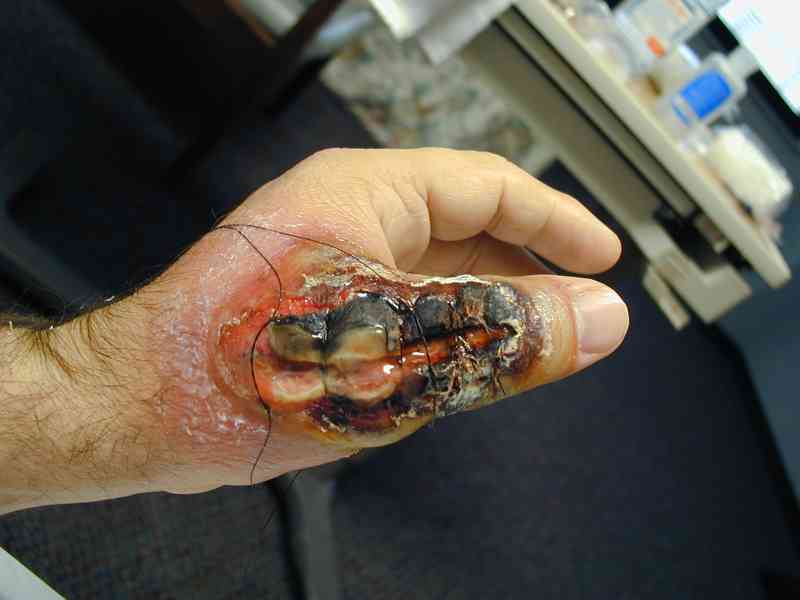
The physical reaction to a brown recluse spider bite depends on the amount of venom injected and an individual's sensitivity to it. Some people are unaffected by a bite, whereas others experience immediate or delayed effects as the venom kills the tissues (necrosis) at the site of the bite. Many brown recluse bites cause just a little red mark that heals without event. The vast majority of brown recluse bites heal without severe scarring (http://spiders.ucr.edu/avoidbites.html).
Initially, the bite may feel like a pinprick or go unnoticed. Some may not be aware of the bite for 2 to 8 hours. Others feel a stinging sensation followed by intense pain. Infrequently, some victims experience general systemic reactions that may include restlessness, generalized itching, fever, chills, nausea, vomiting, or shock. A small white blister usually initially rises at the bite site surrounded by a swollen area. The affected area enlarges and becomes red, and the tissue is hard to the touch for some time. The lesion from a brown recluse spider bite is a dry, blue-gray or blue-white, irregular sinking patch with ragged edges and surrounding redness--termed the "red, white, and blue sign." The lesion usually is 1� inches by 2� inches or smaller. Characteristics of a bite are further discussed at http://www.amednews.com/free/hlsa0805.
The bite of the brown recluse spider can result in a painful, deep wound that takes a long time to heal. Fatalities are extremely rare, but bites are most dangerous to young children, the elderly, and those in poor physical condition. When there is a severe reaction to the bite, the site can erupt into a "volcano lesion" (a hole in the flesh due to damaged, gangrenous tissue). The open wound may range from the size of an adult's thumbnail to the span of a hand. The dead tissue gradually sloughs away, exposing underlying tissues. The sunken, ulcerating sore may heal slowly up to 6 to 8 weeks. Full recovery may take several months and scarring may remain.
It is difficult for a physician to accurately diagnose a "brown recluse bite" based simply on wound characteristics. It is absolutely necessary to have the spider for a positive identification. Necrotic wounds can result from a variety of agents such as bacteria (Staphylococcus, "flesh-eating" Streptococcus, etc.), viruses, fungi, and arthropods (non-recluse spiders, centipedes, mites, ticks, wasps, bedbugs, kissing bugs, biting flies, etc.). Necrotic conditions also can be caused by vascular and lymphatic disorders, drug reactions, underlying diseases states, and a variety of other agents. An annotated list of conditions that could be mistaken for a brown recluse spider bite is available at http://www.ama-assn.org/amednews/2002/08/05/hlsa0805.htm. Misdiagnosis of lesions as brown recluse bites can delay appropriate care.
Dude, eww! Those pictures put me right off my dinner, they did.
Let's lighten this thread a little (warning - not 56k friendly):


EDIT: These are taken from User Friendly.
Huh? Only 1 Starbucks on Antartica?
The brown recluse spider is pretty bad ass. That picture doesnt do it justice, its not that its a huge spider, but what it can do to a person is absolutely horrifying.

Big post I know, but sometimes you just need to share the happiness of the world with everyone!
Thats what happnes when it bites you.
Are all of these pictures from google?
Those pictures are pretty nasty.
/me bites into a slice of pizza.
Can it get any nastier?
Cloral wrote:Huh? Only 1 Starbucks on Antartica?
One Starbucks for every 4 people in a mile radius sounds about right, actually. Unfortunately, they all work there.
Do you think one starbucks is okay? What I like there is green tea frappe by the way.
cachitin wrote:Do you think one starbucks is okay? What I like there is green tea frappe by the way.
Do I see another spammer? I don't drink coffee or tea.